R. Gordon Wasson
How to Change Your MindR. Gordon Wasson was an American writer and amateur mycologist whose account of a 1955 mushroom ceremony helped make psilocybin mushrooms a subject of widespread American interest. His importance rests both on the reach of his 1957 Life magazine article and on the interpretive conflict at its center: Wasson saw the mushrooms as a possible key to the beginnings of religion, while the Mazatec practice he encountered had contemporary purposes he knew were not simply a search for God. His publication carried a local ceremony into international view, with consequences for María Sabina and Huautla de Jiménez that Wasson later regretted.
Identity and the Search for the Sacred Mushroom
Wasson pursued an ambitious theory about the origins of religious belief: that visions induced by psychoactive mushrooms had first kindled humanity’s religious impulse. He spent decades seeking evidence for it, embarking on a thirty-year quest to find what he called the divine mushroom. The journey was not merely botanical. He hoped the mushrooms might illuminate how people came to imagine worlds beyond ordinary experience, and perhaps the divine itself.
That framework shaped what he noticed and how he told the story. Wasson approached the mushrooms as evidence in an argument about human religious history, rather than as only one element in a local tradition. His account would give readers a dramatic encounter with the ceremony, but its larger claims reached beyond what one night could establish: he proposed that mushroom visions might have planted the very idea of God in early human beings. The book presents this as Wasson’s hypothesis, not as a demonstrated conclusion.
The Huautla Ceremony
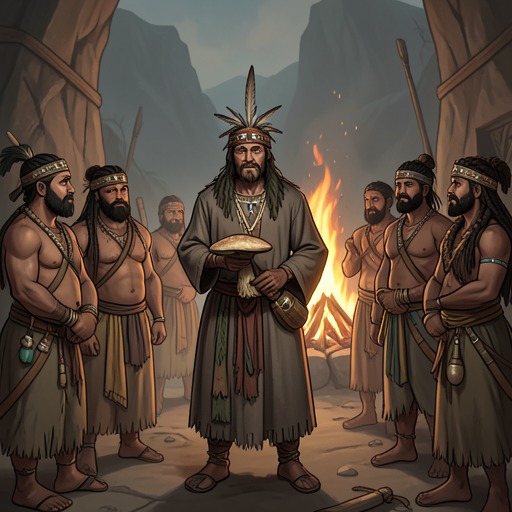
On the night of June 29–30, 1955, during his third trip to Huautla de Jiménez, Wasson persuaded María Sabina, a sixty-one-year-old Mazatec curandera respected in her village, to let him and his photographer participate in a ceremony. The velada took place after dark in the basement of a local official’s home. Its altar was adorned with Christian images, a detail that complicates any simple division between an indigenous rite and Christianity. Before giving Wasson the mushrooms, María Sabina cleaned them and passed them through incense smoke; she called them little children. He received six pairs.
Wasson had gained access by telling María Sabina that he was worried about his son and wanted to know where he was and whether he was well. The account says Wasson received accurate information on both matters, which he discovered after returning to New York. But he knew that Mazatecs used mushrooms for healing and divination, including to locate missing people and important objects. His stated concern therefore aligned with a recognized use of the ceremony, even as he later presented the experience through his own larger theory of religion.
In the published account, Wasson described himself and his photographer as the first white men in recorded history to eat the mushrooms. That is the claim made in his article, which presented the night as a remarkable encounter with a practice that had long been secret from outsiders. The experience left him awestruck and, in his view, strengthened his belief that the mushrooms had opened a door to worlds beyond ordinary human horizons. The ceremony thus became, in his writing, both a personal experience and a proposed origin point for religious imagination.
Interpretation and the Mazatec Practice
The history behind the ceremony included centuries of pressure against indigenous mushroom use. After the Spanish conquest, sacramental use had been driven underground; Spanish authorities and clergy treated mushroom ceremonies as a threat to church authority. Accounts from the colonial period describe efforts to suppress the practices, including the destruction of mushroom stones, sculptures associated with sacred fungi. This history helps explain the secrecy Wasson encountered, but it does not mean the ceremony in 1955 simply preserved an unchanged ancient sacrament.
By then, many Mazatecs were devout Catholics, and the mushrooms were used for healing and divination rather than solely for worship. Wasson knew this, yet his account emphasized religious communion and the possibility that mushroom visions had generated belief in God. María Sabina later made the distinction plainly: before Wasson, she said, people did not take the mushrooms only to find God; they took them to help the sick get well. Her account shifts the focus from Wasson’s universal theory to the practical and religious life of the community whose ceremony he entered.
The contrast does not erase the religious meanings Wasson found in his experience, nor does it establish that the practice had no sacred dimensions. It does show the limits of allowing an outsider’s interpretation to stand in for local use. Wasson’s account connected the ceremony to a sweeping history of religion; María Sabina’s later explanation foregrounded care for the sick. The difference is central to his legacy: the same experience could be made to serve a theory about humanity’s origins while belonging, in its immediate setting, to a specific community and its forms of healing.
Publication and Unintended Consequences
Life magazine offered Wasson an unusually generous contract for his story. It paid him $8,500 and gave him final approval over the editing, headlines, and captions. The magazine also required that the article describe his sensations and fantasies under the mushrooms. Published in 1957, the resulting feature made his account accessible to a broad audience and helped launch the psychedelic revolution in America. Three years later, Timothy Leary encountered psilocybin in Mexico; the book links that moment to the public interest Wasson’s article had helped create.
Wasson did not fully protect María Sabina’s identity. The same week the Life article appeared, he self-published Mushrooms, Russia, and History, retelling her story without disguising her name. Publicity drew thousands of visitors to Huautla, including, eventually, celebrities such as Bob Dylan, John Lennon, and Mick Jagger. The village became first a beatnik destination and then a hippie mecca; mushrooms that had been closely guarded were sold openly on the street.
The consequences fell especially heavily on María Sabina and her community. Neighbors blamed her for the attention; her home was burned, and she was briefly jailed. Wasson later accepted responsibility for unleashing commercial exploitation on Huautla. Near the end of her life, María Sabina regretted sharing the mushrooms with him and, through him, with the world. The story’s reversal is stark: a publication that carried Wasson’s account to millions also helped turn a protected practice into a public attraction, while the person who had allowed him into the ceremony bore much of the local cost.
Later Legacy
Wasson’s influence persisted in later accounts of psychedelic experience. In 1977, Paul Stamets hosted two of his heroes, Wasson and Albert Hofmann, at a conference. Decades after the Huautla ceremony, the narrator of the book, during a psilocybin session, saw Mary Cosimano as María Sabina: the vision drew on the image of the curandera who had given Wasson mushrooms in a basement in Huautla. The narrator did not tell Mary Cosimano at once; later, she was flattered, because María Sabina was her hero. This episode shows how Wasson’s story helped make Sabina an enduring figure in the modern imagination, even as it recalls the cultural costs of that visibility.
The book also places Wasson’s early role beside the later reversal in Life magazine’s public posture. In 1966, the magazine published a highly alarmed cover story about LSD, although nine years earlier it had helped popularize psychedelic experience through Wasson’s enthusiastic account of psilocybin. That contrast does not make the two substances or stories identical. It does underline how quickly public attention could move from fascination to condemnation. Wasson’s lasting significance lies in this unsettled inheritance: he opened a powerful channel between a Mazatec ceremony and Western audiences, advanced an influential theory about religion, and helped set in motion attention that the people at the origin of his story had not asked to bear.